
Run Inspector Hooks
Next to the output, the run inspector shows what a run did: the SQL statements it ran, the mail it sent, log messages, HTTP requests, jobs, events, rendered HTML, and sections your driver adds, such as "Cache" or "Payments". Drivers report all of it to one Runlet\Inspector per run. This page shows what's recorded without any code, and how a project driver adds more.
Runlet passes the inspector to your driver's inspect(Inspector $inspector) after bootstrap(), before the snippet runs. It never calls inspect() when it only lists commands. Turning the inspector off (Settings ▸ General ▸ Run Inspector ▸ Record queries, mail, and logs) records nothing, and inspect() isn't called.
What Is Recorded Without Any Code
| Project | Queries | Log | How | |
|---|---|---|---|---|
| Laravel, Lumen, Laravel Zero | Yes | Yes, with interception | Yes | The application's events: QueryExecuted, MessageSending, MessageLogged, and JobQueued for mail pushed to a queue. |
| Eloquent without Laravel (illuminate/database through Capsule, as in a Slim or PHP-DI app) | Yes | – | – | The connections Eloquent models use, or Capsule's global instance. |
| WordPress | Yes | wp_mail(), with interception on 5.7+ | – | $wpdb with SAVEQUERIES, and WordPress's mail hooks (WordPress Mail). |
| Symfony | Doctrine connections in the doctrine registry | Symfony Mailer, with interception on 6.3+ | – | DBAL logging, and MessageEvent on the event dispatcher. |
| Standalone Doctrine DBAL, plain PDO | With one line in your driver | – | – | inspectDoctrine(), $inspector->watchPdo(). |
Detection runs after your driver's bootstrap(), so a database layer set up there is found. It only looks at classes the application already loaded: it never autoloads anything to find out.
HTTP requests, jobs, and events are recorded without any code too; see HTTP, Jobs, and Events.
Your own inspect() replaces this detection. Call parent::inspect($inspector) to keep it, or leave the method empty to record nothing.
Eloquent Without Laravel
A project driver that boots the app's container gets Eloquent's queries automatically:
<?php
// .runlet/ShopDriver.php
use Runlet\Inspector;
use Shop\Cache;

class ShopDriver extends \Runlet\Driver
{
    private $container;

    public function bootstrap(string $projectPath): void
    {
        // Creates Capsule, calls setAsGlobal() and bootEloquent(), registers services.
        $this->container = require $projectPath . '/config/bootstrap.php';
    }

    public function variables(): array
    {
        return ['container' => $this->container];
    }

    public function inspect(Inspector $inspector): void
    {
        parent::inspect($inspector); // Eloquent through Capsule, found automatically

        // A Doctrine DBAL connection Runlet can't find on its own.
        $this->inspectDoctrine($inspector, $this->container->get('reports'), 'reports');

        // A section of your own.
        Cache::listen(static function (string $operation, string $key, $value) use ($inspector): void {
            $inspector->record('Cache', $operation . ' ' . $key, $value);
        });
    }
}
If the app creates its database layer lazily (a container factory that runs on first use), pass it explicitly: $this->inspectEloquent($inspector, $this->container->get(Capsule::class)). inspectEloquent() accepts a Capsule manager, a DatabaseManager, or one Connection.
How Eloquent queries are captured:
- Live (the default). Runlet listens for
QueryExecutedon the connections' event dispatcher. When they have none (Capsule withoutsetEventDispatcher(), the usual case) andilluminate/eventsis installed, Runlet creates a dispatcher for the run and binds it in Capsule's container, so connections opened later get it too. Model events stay off: Eloquent's own dispatcher isn't changed. Queries arrive as they run, with the snippet's line. - Query log (the fallback). Without
illuminate/events, Runlet turns on each connection's query log (creating the configured connections first, which opens nothing: PDO connects on first use). A query is reported when the next one starts and at the end of the run, so the list fills in a step behind. On Laravel 8 and later, queries still get their snippet line; on older versions they don't.
Doctrine DBAL
public function inspect(Inspector $inspector): void
{
    parent::inspect($inspector);
    $this->inspectDoctrine($inspector, $this->entityManager->getConnection(), 'default');
}
DBAL 2 and 3 get an SQL logger, chained to one the app already set. DBAL 4 gets a timing middleware around the connection's driver, or around the open driver connection when it's already connected. The Symfony driver does this for every connection in the doctrine registry.
Plain PDO
PDO can't be hooked globally, so a driver (or a snippet) opts in per connection:
public function inspect(Inspector $inspector): void
{
    $inspector->watchPdo($this->container->get(PDO::class), 'app');
}
watchPdo() installs a statement class that reports every prepare() and execute() with its bound values and time. It skips connections that already use their own statement class (as database layers often do) and persistent connections, and it can't see PDO::query() or PDO::exec().
Built-in hooks tell the Queries section which database API ran a statement (Eloquent, Doctrine, WordPress, or PDO), so its Explain action can prepare a PHP tab that reaches the same connection. A statement you report yourself can say so too (databaseAPI in $details); without it, Explain prepares a PDO template that asks you to recreate the connection.
HTTP, Jobs, and Events
The HTTP, Jobs, and Events sections record without any code on these projects:
| Project | HTTP | Jobs | Events |
|---|---|---|---|
| Laravel, Lumen, Laravel Zero | The Http client: Laravel 8.45 and later (RequestSending, ResponseReceived), failed connections from 8.48 (ConnectionFailed), with their error from 11.16 | Queued jobs from Laravel 8.24 (JobQueued; the queue and delay on the event from 11.0, else read from the job), and JobQueueing from 10.42; jobs run during the run (JobProcessing, JobProcessed, JobFailed, JobExceptionOccurred, JobReleasedAfterException) | Every dispatched event, when Record events is on |
| WordPress | wp_remote_get() and the rest of WP_Http, from pre_http_request to http_api_debug | – | – |
| Symfony | HttpClient's http_client service and scoped clients, with the profiler on: Symfony 4.4 and later, read from TraceableHttpClient at the end of the run | Messenger: messages sent to a transport (SendMessageToTransportsEvent, 4.3 and later), a sync:// transport's handling, a worker's messages (WorkerMessageReceivedEvent, WorkerMessageHandledEvent, WorkerMessageFailedEvent), and, with the profiler on, messages a bus handled right away (TraceableMessageBus). See Symfony for what each version adds. | – |
| Eloquent without Laravel, other projects | – | – | – |
A project driver can report its own requests and jobs (below).
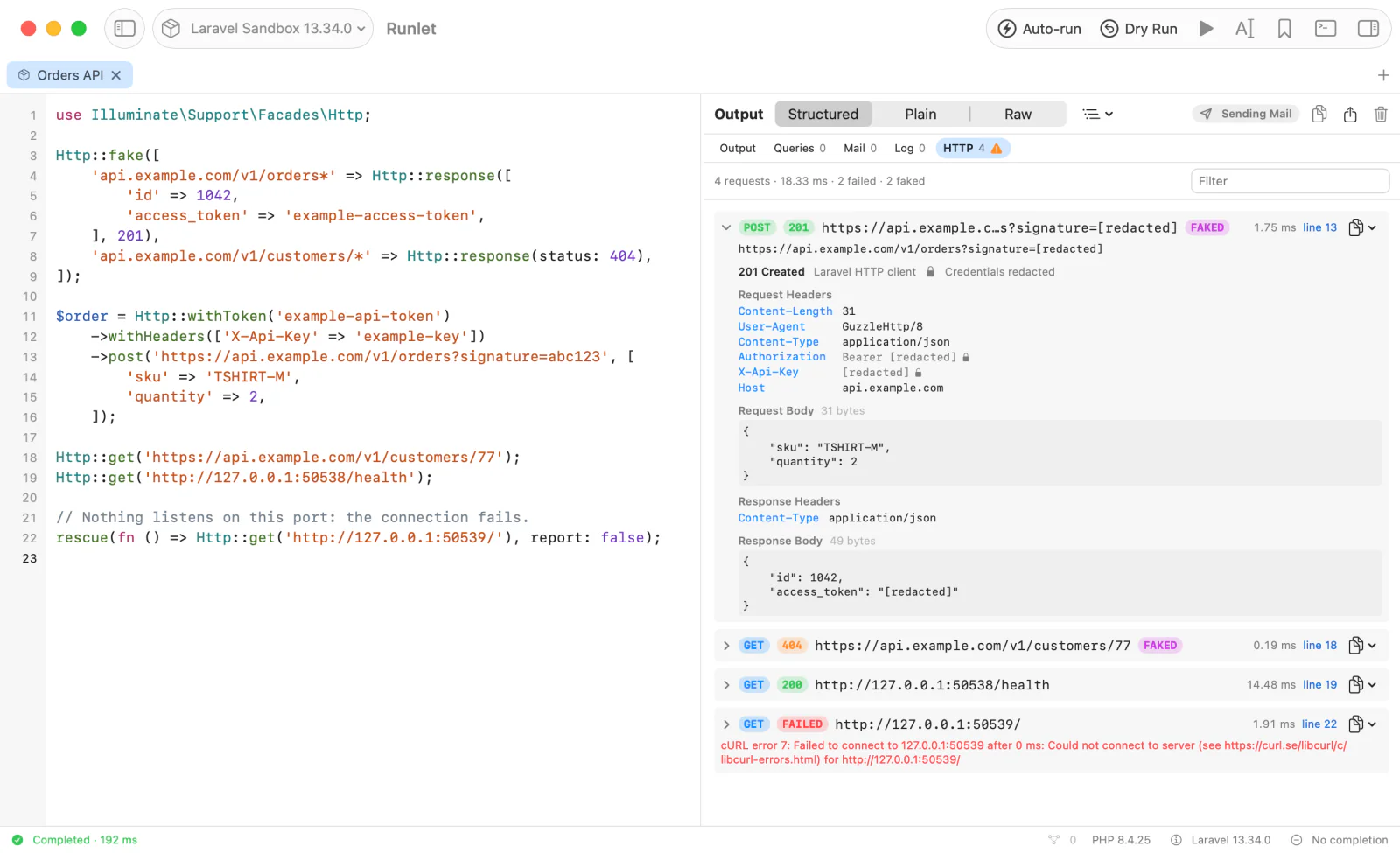
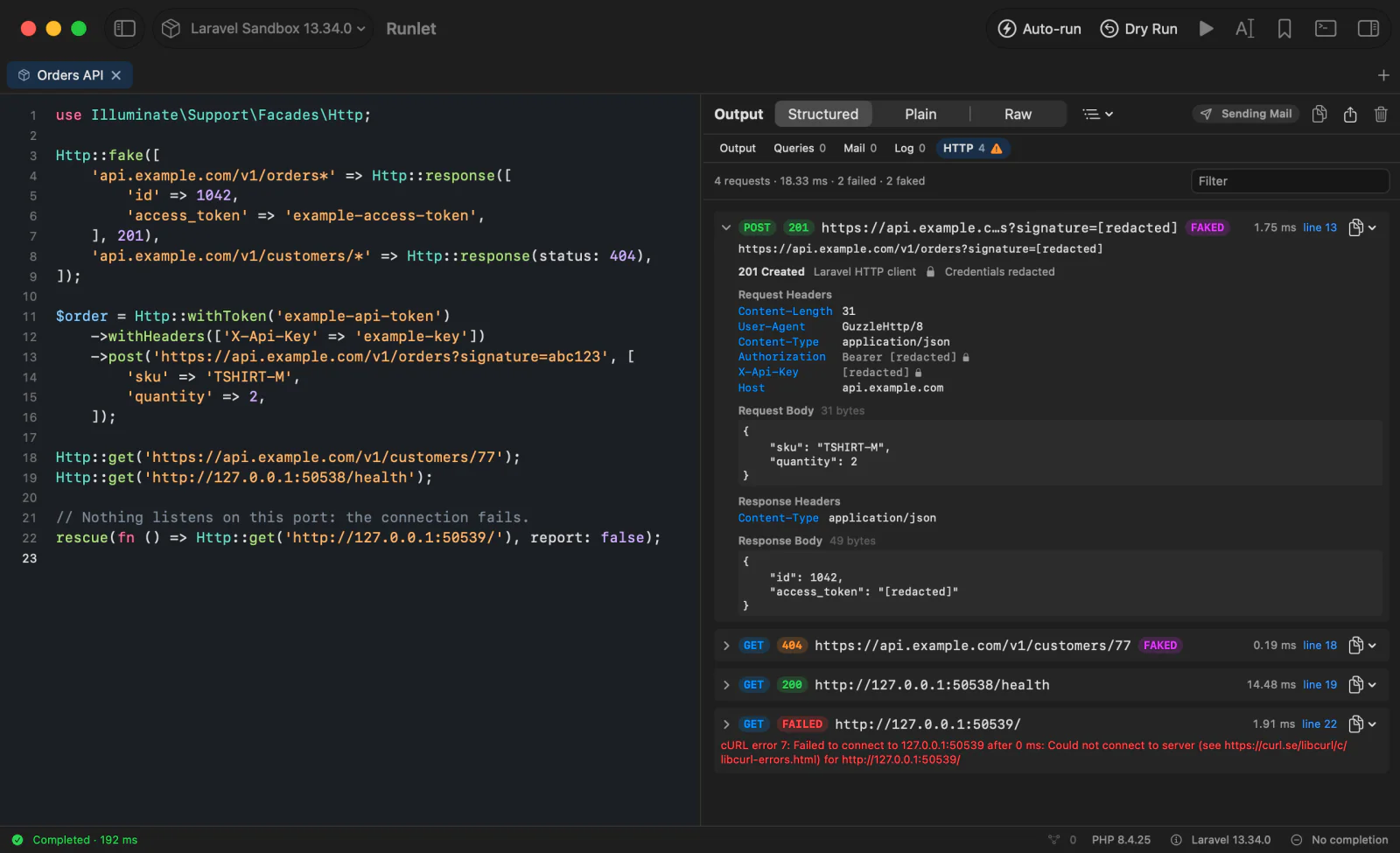
On an older Laravel, an event that doesn't exist yet is never fired: its section stays empty, and nothing else changes. The sections attach once the application booted, so requests and jobs while it boots aren't recorded, as with queries.
- Faked responses. A response from
Http::fake()is marked FAKED: Runlet sees that the factory has fakes and that the response had no network transfer. In WordPress, a request anotherpre_http_requestcallback answered is marked faked. - Pairing and timing. Each
RequestSendingis paired with itsResponseReceived, or with theConnectionFailedfor the same method and URL, and timed between them. A request with no answer by the end of the run is listed with an error. - Sync jobs. A job that runs during the run is timed from
JobProcessingtoJobProcessedorJobFailed. Jobs on a connection with thesyncdriver are listed as they run, not as queued, and queued mail follows the same rule in Mail. - What a wrapper runs. For
SendQueuedMailable,SendQueuedNotifications,CallQueuedListener,BroadcastEvent, andCallQueuedClosure, the row shows the mailable, notification, listener, event, orClosure: read from the job's properties and Laravel's queue payload, so no code of yours runs. - Events. A wildcard listener (
*), registered after the application's own listeners, records each event's name and a summary of its payload, and returns nothing, so it can't stop an event. With it on,Event::dispatch()returns one morenullin its list of listener responses.
Symfony
Symfony's HttpClient fires no events, and its services can't be wrapped once the container is compiled without changing your application. Messenger fires events when it sends a message to a transport and when a worker handles one, but none when a bus handles a message right away. The Symfony profiler fills both gaps: with framework.profiler on (symfony/web-profiler-bundle turns it on in dev), Symfony wraps every HTTP client in a TraceableHttpClient and every bus in a TraceableMessageBus, which keep what went through them. Runlet only reads those lists, and only from services the application already created: it never calls, creates, or resets them.
- When. HTTP requests and Messenger messages are listed when the run ends: requests in the order they were sent, messages in the order they were dispatched. A worker resets the services after each message, which empties the profiler's lists, so Runlet reads them first.
- Requests show the headers the transport really sent (the scoped client's defaults and auth options included), read from the response's
debuginfo, and have no snippet line: the trace doesn't say where a request came from. A refused connection is listed without its error, because the trace has no info for it. A response fromMockHttpClientis marked faked. A client made withHttpClient::create()isn't traced, so it isn't listed. - Messages are matched to the profiler's dispatches by the message object. A worker's or a
sync://transport's redispatch of a message isn't listed again, and a failed message shows the handler's exception, unwrapped fromHandlerFailedException.
What Messenger records depends on the Symfony version and the profiler:
| Symfony | Without the profiler | With the profiler |
|---|---|---|
| 7.4 and later | Sent messages are QUEUED with their transport, delay, and the transport's message ID (MessageSentToTransportsEvent). A sync:// message is timed; one whose handler threw is listed as DIDN'T FINISH. | Also: messages a bus handled right away (PROCESSED or FAILED, without a time), and a sync:// message's exception. |
| 6.2 to 7.3 | Sent messages are QUEUED with their transport and delay, without the ID. A sync:// message is PROCESSED, without a time, even when its handler threw. | Also: the message ID, a sync:// message's exception, and messages a bus handled right away. |
| 4.4 to 6.1 | The event doesn't name the transports: every sent message is QUEUED without its transport, a sync:// one too. | The transports and the ID, from the sent stamps, so sync:// messages are told apart; and messages a bus handled right away. |
A worker's messages are listed the same way on every version: PROCESSED, FAILED, or RELEASED (willRetry()), with their time, receiver, and attempt.
Recording From Your Driver
Report requests, jobs, and events from your own clients and queues with the same methods. Runlet redacts the credentials itself, and does nothing when the run doesn't record that section:
public function inspect(Inspector $inspector): void
{
    parent::inspect($inspector);
    if (!$inspector->shouldRecord(Inspector::HTTP)) {
        return;
    }

    $this->container->get(ApiClient::class)->onResponse(function ($request, $response, float $ms) use ($inspector) {
        $inspector->http([
            'client' => 'ApiClient',
            'method' => $request->method,
            'url' => $request->url,
            'status' => $response->status,
            'durationMs' => $ms,
            'requestHeaders' => $request->headers,
            'responseHeaders' => $response->headers,
            // Kept only when the run records bodies.
            'responseBody' => $response->body,
        ]);
    });
}
Custom Sections, Logs, and HTML
public function inspect(Inspector $inspector): void
{
    parent::inspect($inspector);
    $inspector->section('Payments'); // shown even when the run makes none

    $this->container->get(PaymentGateway::class)->onCharge(function ($charge) use ($inspector) {
        $inspector->record('Payments', $charge->id . ' ' . $charge->currency, [
            'amount' => $charge->amount,
            'status' => $charge->status,
        ]);
    });
}
A snippet can report too: \Runlet\Inspector::current()->record('Debug', 'cart', $cart). For a card in the output instead of a record, use \Runlet\notice(), \Runlet\warning(), or \Runlet\error() (also $inspector->notice(), ->warning(), and ->error()): they show the calling line and never fail the run, with the inspector on or off. See the snippet API.
Inspector Methods
| Method | Purpose |
|---|---|
query(string $sql, array $bindings = [], ?float $ms = null, ?string $connection = null, array $details = []) | One statement in Queries. $details: driver (mysql, pgsql, sqlite, …), rawSql (the statement with the bindings your database layer substituted), location (from location(), for a statement reported after it ran), and databaseAPI (eloquent, doctrine, wordpress, or pdo). |
mail($message, array $details = []) | One message in Mail: a Symfony Mime Email, a SwiftMailer message, or an array with subject, from, to, cc, bcc, replyTo, html, text, attachments, mailer, mailable, and caller (who sent it when that isn't the snippet, shown as Sent by). $details adds intercepted, error (why sending failed; the message shows as Failed), queued, queueConnection, and location. Inline cid: images become data: URLs. |
log(string $level, string $message, array $context = [], ?string $channel = null) | One message in Log. |
html(string $title, string $html, string $section = 'HTML') | Rendered HTML, previewed in a locked-down web view. |
record(string $section, string $title, $value) | Any value in a section of your own, shown like a dump (bounded, and no methods are called except your driver's casters). |
http(array $request) | One request in HTTP: method, url, status (none when no response came), reason, durationMs, requestHeaders and responseHeaders (name => value or list of values), requestBody and responseBody (kept only when the run records bodies), requestBodySize and responseBodySize, error, faked, client, and location. Credentials are redacted. |
job(array $job) | One job in Jobs: status (queued, processed, failed, released, unfinished, notQueued), class, name (what a wrapper runs), connection, queue, delay (seconds), id, uuid, attempts, durationMs, exception (a Throwable, or class and message), and location. |
event(string $name, $payload = null, array $details = []) | One event in Events, with a short summary of its payload. Only when the run records events. |
shouldRecord(string $section): bool, shouldRecordHttpBodies(): bool | Whether the run records Inspector::HTTP, Inspector::JOBS, or Inspector::EVENTS (other sections follow isEnabled()), and HTTP bodies. Check them before attaching listeners you don't need. |
section(string $section) | Shows a section even when nothing is recorded in it. |
watchPdo(\PDO $pdo, string $connection = 'pdo'): bool | Records a PDO connection's prepared statements (above). |
shouldInterceptMail(): bool, interceptingMail(), cannotInterceptMail(string $reason) | Mail interception. |
once(string $key): bool, atFinish(callable $callback), location(): array | Helpers for hooks: attach once, flush something when the run ends, and capture where the code running now came from. |
notice(string $message, array $context = []), warning(…), error(string|\Throwable $message, array $context = []) | A notice, warning, or non-fatal error card in the output, not a record. Shown with the inspector off too. |
Inspector::current() | The run's inspector, or null outside a run. |
No method throws, so they're safe inside listeners. Each record carries the snippet line that caused it, or the first project file outside vendor/. If inspect() itself throws, Runlet shows a notice and the run continues.
Mail Interception
Intercept mail (Settings ▸ General ▸ Run Inspector, off by default) asks drivers to record mail without sending it. Local projects, Docker profiles, and SSH profiles can override it in their Mail option. The output says which messages were intercepted, and the run's header says interception is on.
- Laravel: Runlet's
MessageSendinglistener returnsfalse, so Laravel builds the whole message (views, attachments) and then sends nothing. Notifications sent through the mail channel are covered too. Mail pushed to an asynchronous queue (Mail::queue(), or mailables that implementShouldQueue, on a connection other thansync) is sent later by a queue worker, outside the run, so Runlet can't intercept it: it lists it as "queued" instead. - Symfony Mailer 6.3 and later:
MessageEvent::reject(). Older versions are recorded, not intercepted. - WordPress 5.7 and later: Runlet's
pre_wp_mailfilter, the last one, answers for the message, sowp_mail()stops before PHPMailer and tells its caller the mail was sent. Runlet confirms interception only when it's guaranteed, and otherwise says why (WordPress Mail). - Your driver: check
$inspector->shouldInterceptMail(), stop the message, record it with['intercepted' => true], and call$inspector->interceptingMail()so Runlet knows. When interception is on and no driver confirms it, Runlet warns that mail is delivered normally. When your driver knows why it can't intercept, pass the reason to$inspector->cannotInterceptMail($reason): the warning and the mail chip quote it.
Mail sent some other way (a raw SMTP client, or an HTTP API such as Mailgun's SDK) is neither recorded nor intercepted.
WordPress Mail
With the run inspector on, the WordPress driver records every wp_mail() message: To, Cc, Bcc, From, Reply-To, the subject, the HTML or text body for the preview, attachments with their sizes, inline images as data: URLs, and Sent by: the plugin, must-use plugin, or theme that called wp_mail() (with its file and line), or the core function, such as WordPress core: retrieve_password().
- A message that fails (
wp_mail_failed, for example an invalid sender or an SMTP error) is listed as Failed, with PHPMailer's error. - A sent message is recorded from what PHPMailer was given, after other plugins'
phpmailer_initchanges. An intercepted one never reaches PHPMailer, so it's recorded fromwp_mail()'s arguments, read the waywp_mail()reads them (its headers, its defaults, and thewp_mail_from,wp_mail_from_name, andwp_mail_content_typefilters). - Runlet adds its hooks before WordPress loads, during its runs only, so mail a plugin sends while WordPress boots (on
init, say) is covered too. No file is added to your site: a must-use plugin isn't needed, and would affect the site outside Runlet.
With Intercept mail on, Runlet confirms interception (in the run's header and the mail chip) only when it's guaranteed. Otherwise the warning says why, and each message shows what really happened to it:
- WordPress before 5.7 has no
pre_wp_mailfilter: messages are recorded and sent. - A plugin or theme replaces
wp_mail()(some SMTP and email-API plugins define their own): "A plugin (acme-smtp) replaces wp_mail(); Runlet can't stop its mail." Runlet leaves thatwp_mail()alone, and records what reaches thewp_mailfilter and PHPMailer. - Another callback on
pre_wp_mailcould send a message itself before Runlet's callback runs (an API mailer that takes over there). Runlet still stops each message that reaches its own callback unanswered, and marks it intercepted; a message another callback answered for is listed as sent.
Mailers that work inside wp_mail(), such as plugins that set PHPMailer up for SMTP or swap it for an HTTP API client, are stopped like any other message, because pre_wp_mail comes before PHPMailer. Mail that WP-Cron events or Action Scheduler jobs send later is sent outside the run, so Runlet neither records nor intercepts it (runs don't spawn WP-Cron), as with Laravel's queued mail.
The Mail Chip
The output header of every PHP tab shows what runs on its target do with mail:
| Chip | Meaning |
|---|---|
| Intercepting Mail (orange) | Mail is recorded, not sent. Interception turns the inspector on for its runs. |
| Sending Mail (grey, or red on a production target) | Mail is sent. |
| Mail: inspector off (dimmed) | The run inspector is off: runs send mail and record nothing. |
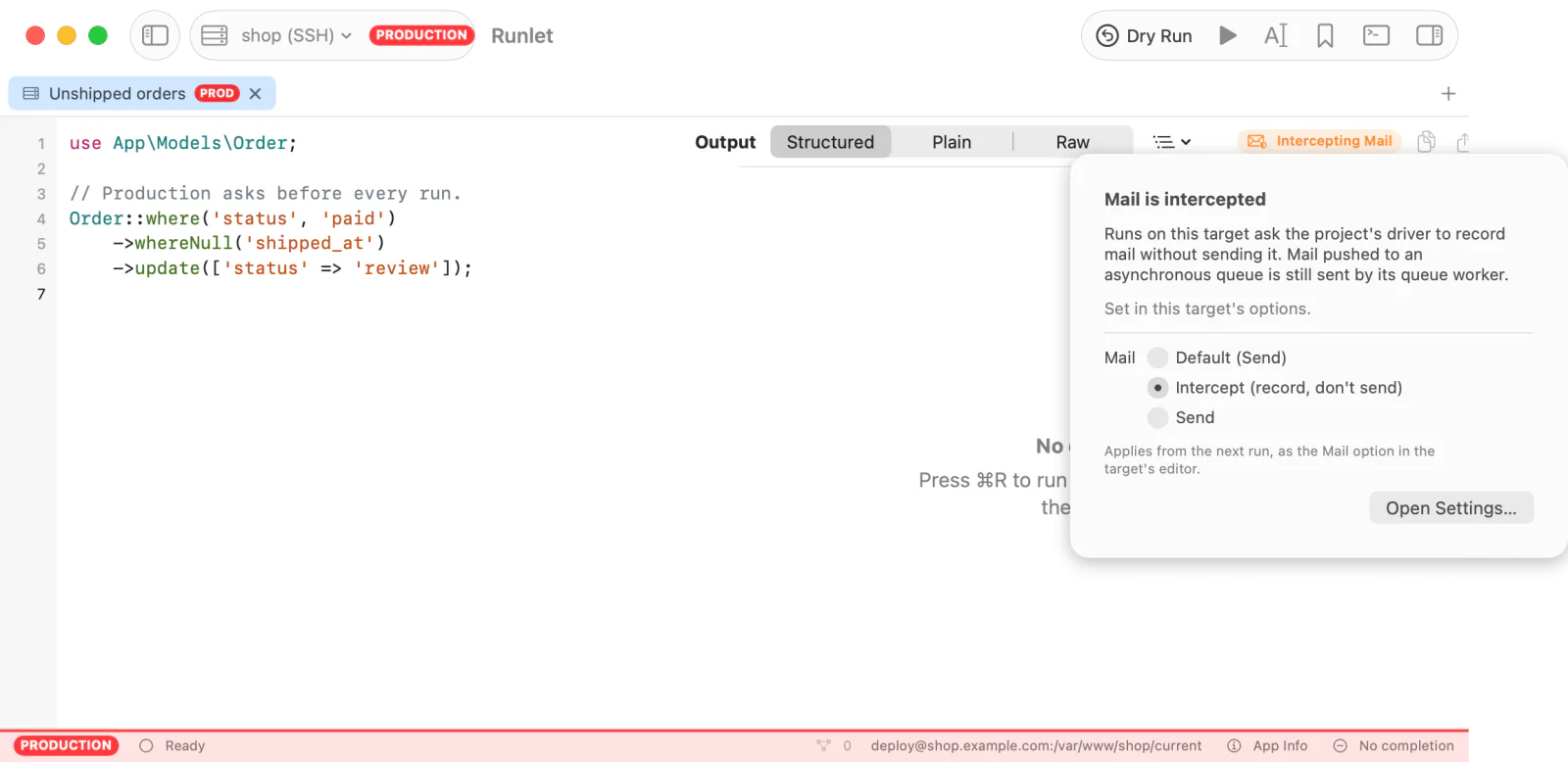
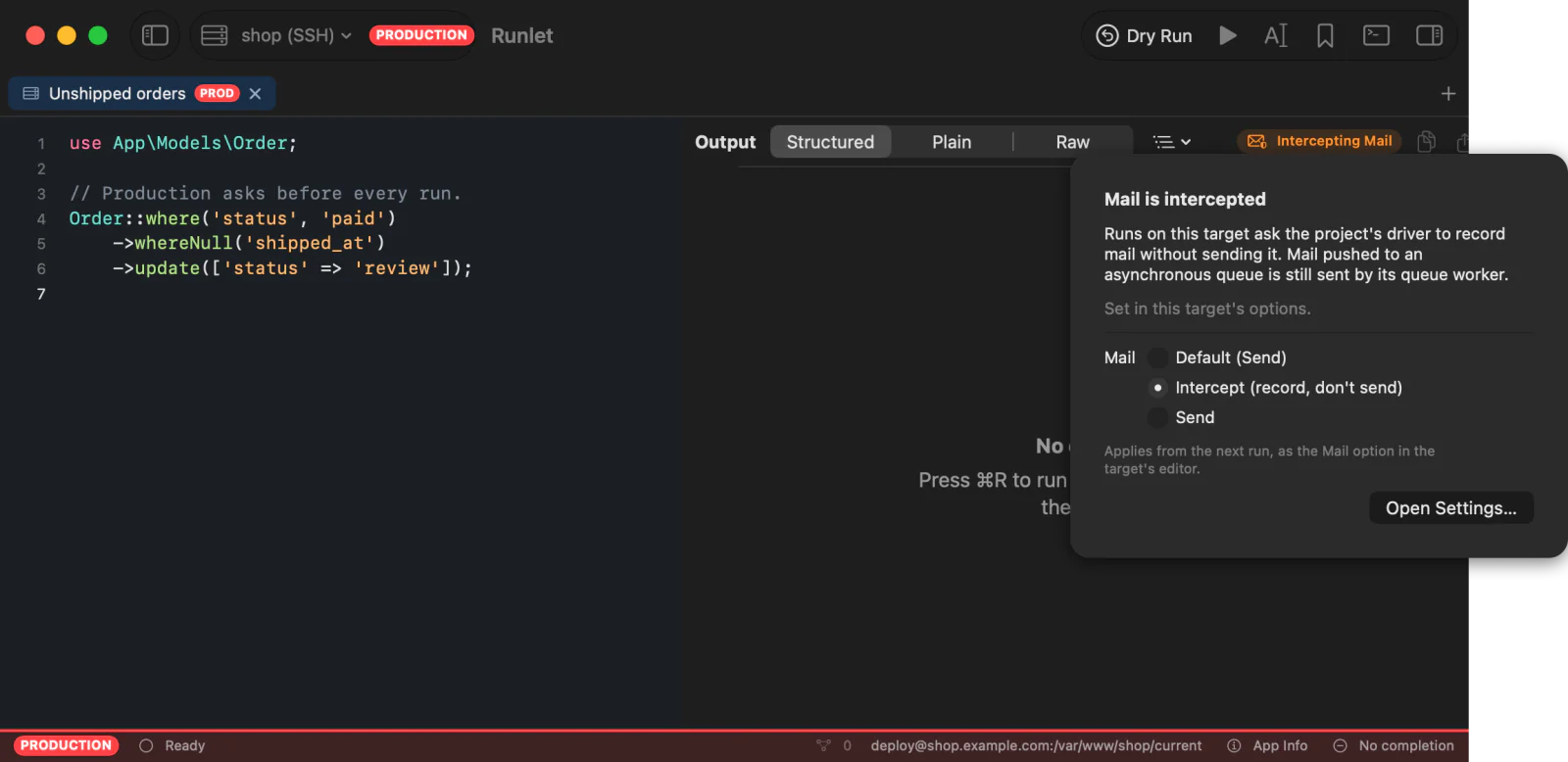
Click the chip to see where the mode comes from ("Set in this target's options", or "Default, from Settings ▸ General ▸ Run Inspector"), and to change it with the same Mail picker as the target's settings: Default, Intercept (record, don't send), or Send. The choice is saved in the target's settings and applies from the next run. The sandbox has no option of its own: its popover changes the default in Settings. Open Settings… opens Settings ▸ General, and with the inspector off, Turn On Run Inspector turns it on.
- Switching a production target that intercepts mail to sending (Send, or Default while Settings says Send) asks first, in the popover. Intercepting never asks.
- After a run on the target asked for interception, the popover says whether the driver confirmed it, or quotes the run's warning. Before such a run, it says nothing about support: that comes from what runs report, not from a list of drivers.
- SQL tabs don't show the chip: they run a statement, not the application's mail code.
Previews
When a snippet returns or dumps an object that renders as HTML, the output shows it next to the value tree, in a web view with JavaScript off, no remote loads (images can be allowed per preview), and no navigation.
Driver::preview($value) decides. The default renders Laravel Mailables (their HTML and text bodies, and subject), MailMessages, a Notification's toMail() (with an anonymous notifiable; return $notification->toMail($user) when it needs a real one), views, Htmlable and Renderable objects, and Symfony responses with HTML content. Rendering runs the application's view code, so its queries appear in the inspector; turn off Preview returned mail, views, and HTML in Settings ▸ General ▸ Run Inspector to skip it.
Override preview() to add your own types:
public function preview($value): ?array
{
    if ($value instanceof \Acme\Pdf\Invoice) {
        return ['title' => 'Invoice ' . $value->number(), 'html' => $value->toHtml()];
    }

    return parent::preview($value);
}
Benchmarks
Runlet\bench() measures code in any snippet, on every target (PHP 7.4 or later, with no extension), and shows a benchmark card where it ran, plus a Benchmarks section:
Runlet\bench(fn () => Str::slug('Ada Lovelace'), 5000, 'Str::slug()');

Runlet\bench([
    'array_map' => fn () => array_map(fn ($x) => $x * 2, $items),
    'foreach' => function () use ($items) { /* … */ },
], 2000);
bench($callables, int $iterations = 1000, ?string $label = null, ?float $seconds = null) takes a callable, or an array of up to 20 callables keyed by label to compare side by side. It takes the same first two arguments as Laravel's Benchmark::measure().
- How it measures. Each callable is called once cold (shown as "First call"), warmed up with up to 1% of the iterations (at most 10), then timed with
hrtime(true)up to$iterationstimes. It stops at 100,000 timed calls per callable, or when the callable has used$seconds(1 second by default, at most 60); the card says how many calls ran. Garbage is collected once before the timed calls, not between them. - The card shows the mean, median, p95, min, max, operations per second, the iterations, the standard deviation, the first call, and memory: the peak above what was in use before the timed calls, and the memory kept per call. (PHP 8.2 and later reset the peak for this; on older PHP, the peak shows only when it rose above the process's earlier peak.) Below them: a histogram of call times, from the fastest up to p99 or to the outlier fence (p75 + 3 × IQR) when that's lower, with median and p95 markers and the slower calls counted; and the mean per chunk of calls, in run order.
- A comparison shows each callable's mean as a bar, how many times slower it is than the fastest, and a table.
- Short calls. Timers tick in steps (41.67 ns on Apple silicon), so the histogram uses one bin per tick when the spread is that narrow, and the card says when calls are so short that the timer dominates.
bench() returns the numbers too, in milliseconds like Laravel's Benchmark: mean_ms, median_ms, min_ms, max_ms, p95_ms, ops_per_sec, iterations, memory_peak_bytes, and memory_per_call_bytes (keyed like $callables when it's an array of callables).
Laravel's Illuminate\Support\Benchmark. Benchmark::dd() is recognised from its dump: Runlet adds a benchmark card with the mean of each callable and the iteration count, and Laravel's own dd() output still shows. Laravel measures only the mean (to the microsecond), so that card has no distribution. Benchmark::measure() and Benchmark::value() return plain numbers and offer no hook, so swap Benchmark::measure( for Runlet\bench( to get the card.
Benchmarks and profiles are recorded even when the inspector is off: the snippet asked for them.
Limits
Per run, Runlet records at most 2,000 statements, 2,000 other records, 8 MiB of record data in all, and 2 MiB per HTML or text body. Values in records are bounded more tightly than results: depth 6, 100 entries per level, 16 KiB per string, and 512 KiB per value. Within those, HTTP keeps 200 requests and 2 MiB, with 8 KB per body; Jobs keeps 500 jobs; and Events keeps 500 events and 1 MiB, with payloads 3 levels deep, 20 entries per level, and 512 bytes per string. What a limit leaves out is counted at the end of its section.
Hooks attach after the application boots, so queries the application runs while booting aren't recorded. On Lumen, the database and events are inspected only when the application resolved them while booting.