
Promote a Snippet
Scratch code that works often belongs in the project. File ▸ Save as Artisan Command… and File ▸ Save as Test… turn the current tab's code into an Artisan command class, or a Pest or PHPUnit test, in the tab's project, for you to review and commit.
Runlet only writes the file, and only where you choose in a save panel. It runs nothing: no Artisan, no tests, no PHP.
Saving a Command or a Test
- Write the snippet, and select part of it if you want only that part. With a selection, the tab's
useimports come along. - Choose File ▸ Save as Artisan Command… or File ▸ Save as Test…. Both are also in the command palette (⇧⌘P), and in the context menu of personal and project snippets in the Snippets panel.
- Pick the folder and file name in the save panel, and save.
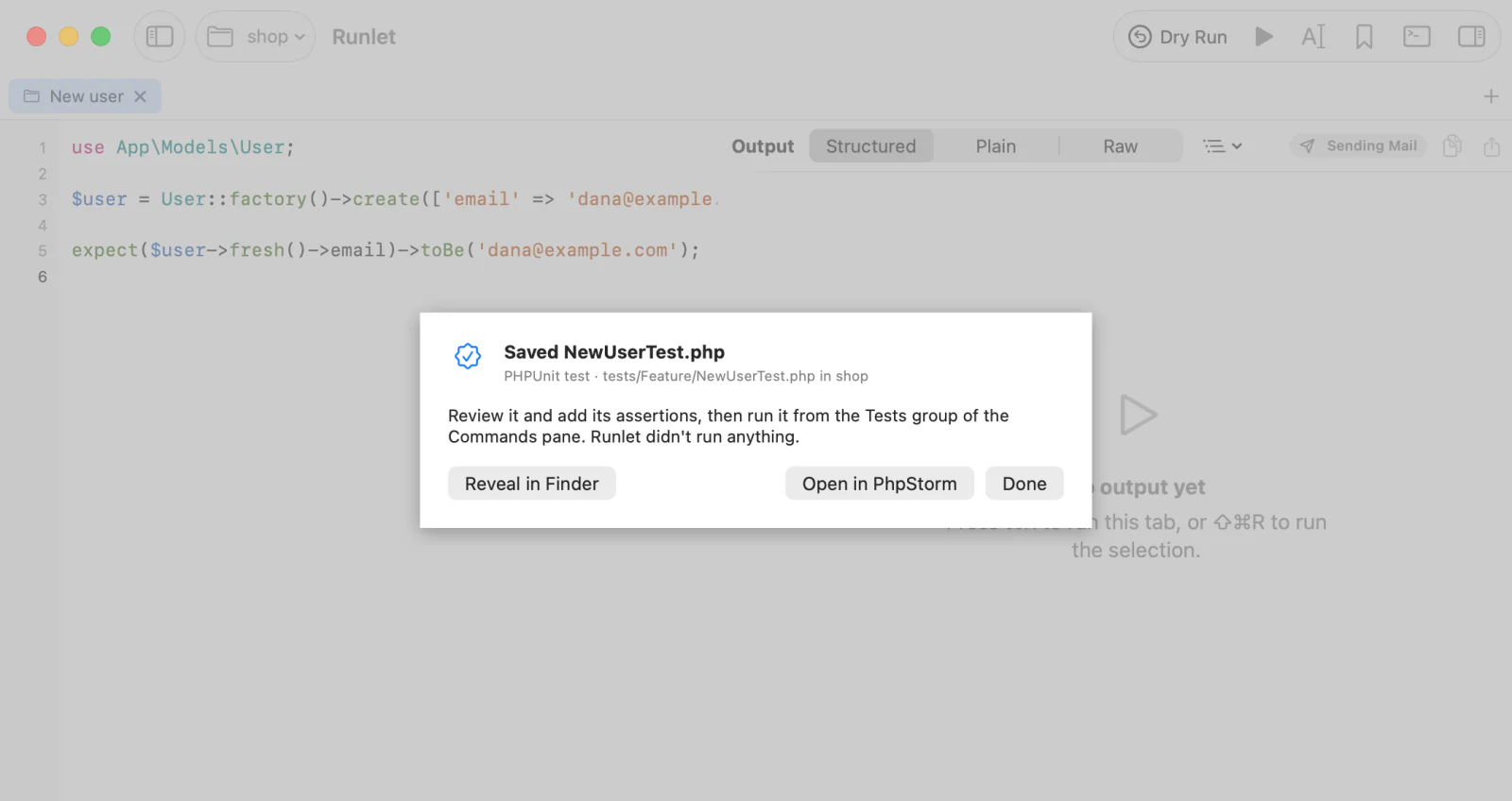
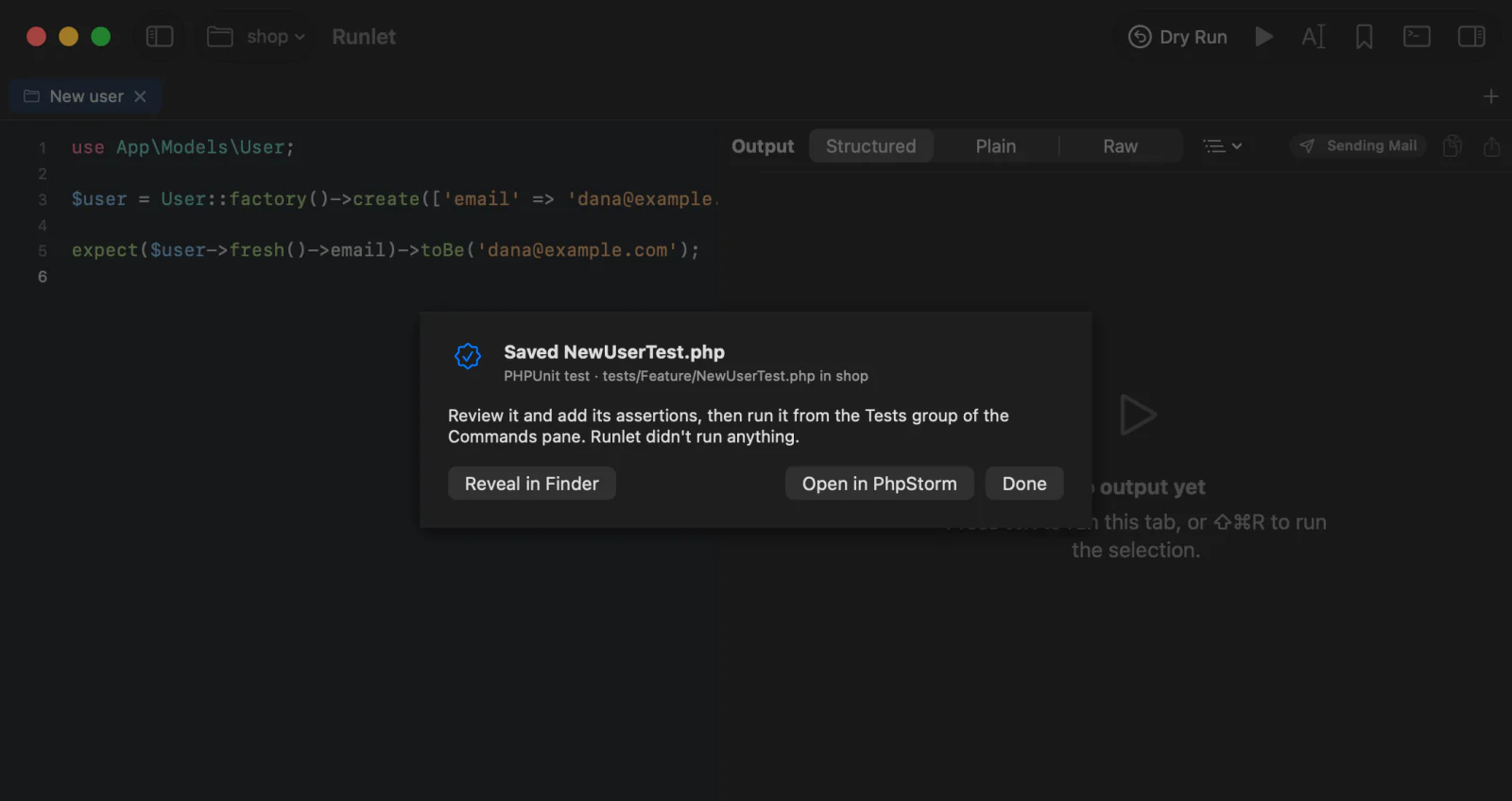
After saving, a sheet shows where the file went and any TODOs in it, with Open in your editor (Settings ▸ Editor ▸ External Editor) and Reveal in Finder.
Where the File Goes
The save panel opens in the tab's project folder:
- A command goes to
app/Console/Commands(app/Commandson Laravel Zero). - A test goes to
tests/Feature.
When that folder doesn't exist, the panel opens in the nearest one that does, and New Folder creates the rest. The file name comes from the tab's title or the snippet's label, such as RefundOrder.php or RefundOrderTest.php. The panel asks before it replaces a file, and stays open on a name that can't work:
- a name that isn't a PHP class name (letters, digits, and underscores, starting with a letter, and not a reserved word);
- a test file whose name doesn't end in
Test.php, since Pest and PHPUnit only run those; - a name the snippet already imports, such as
Order.phpwithuse App\Models\Order;.
The class name is the file name, and the namespace follows the folder through your composer.json's PSR-4 autoload map (app/Console/Commands is App\Console\Commands, tests/Feature/Orders is Tests\Feature\Orders), so the class autoloads where you saved it.
When They're Available
| Target | Save as Artisan Command… | Save as Test… |
|---|---|---|
| Local project | Laravel, Lumen, or Laravel Zero | Yes |
| Docker profile with a local source folder | Laravel, Lumen, or Laravel Zero | Yes |
| SSH profile with a local folder (its checkout on your Mac) | Laravel, Lumen, or Laravel Zero | Yes |
| The sandbox, or a profile without a local folder | No | No |
| SQL tabs | No | No |
A disabled command says why in the command palette and in its menu item's tooltip. Runlet knows the framework from the target's last run, or from the project's files; a project that hasn't been detected yet counts as Laravel when it has an artisan file.
What the Generated Code Looks Like
Take this snippet with inputs:
<?php

/**
 * Refund an order and tell the customer.
 *
 * @input int $orderId "Order ID"
 * @input string $reason "Reason" = "duplicate" {duplicate, fraudulent, requested_by_customer}
 * @input bool $notify "Email the customer" = true
 */

use App\Models\Order;
use App\Notifications\OrderRefunded;

$order = Order::findOrFail($orderId); //?
$order->refund($reason);

if ($notify) {
    $order->customer->notify(new OrderRefunded($order));
}

$order->fresh()->status
As an Artisan Command
Save as Artisan Command… writes app/Console/Commands/RefundOrder.php, in the style of php artisan make:command:
class RefundOrder extends Command
{
    protected $signature = 'app:refund-order
                            {orderId : Order ID}
                            {--reason= : Reason (one of duplicate, fraudulent, requested_by_customer; default: duplicate)}
                            {--no-notify : Turn off: Email the customer}';

    protected $description = 'Refund order';

    public function handle()
    {
        /**
         * Refund an order and tell the customer.
         */

        $orderId = (int) $this->argument('orderId');
        $reason = $this->option('reason') ?? 'duplicate';
        $notify = ! $this->option('no-notify');

        $order = Order::findOrFail($orderId);
        $order->refund($reason);

        if ($notify) {
            $order->customer->notify(new OrderRefunded($order));
        }

        dump($order->fresh()->status);
    }
}
The file also has <?php, the namespace, the imports, and the docblocks of Laravel's stub.
As a Test
Save as Test… writes a Pest test when the project uses Pest (pestphp/pest in composer.json, vendor/pestphp/pest, or tests/Pest.php). Otherwise it writes a PHPUnit class that extends the project's Tests\TestCase, or PHPUnit\Framework\TestCase when there is none:
<?php

use App\Models\Order;
use App\Notifications\OrderRefunded;

test('Refund order', function () {
    // TODO: Choose a test value for $orderId (Order ID): its input has no default.

    /**
     * Refund an order and tell the customer.
     */

    $orderId = 0;
    $reason = 'duplicate';
    $notify = true;

    $order = Order::findOrFail($orderId);
    // …
    $result = $order->fresh()->status;

    // TODO: Assert the snippet's result, for example: expect($result)->toBe(...);
});
How the Code Changes
- The opening tag and imports.
<?phpgoes, anduselines move to the file's imports, sorted, with the base class's (Illuminate\Console\Command,Tests\TestCase). When an import already takes the base class's name, the class extends it by its full name instead. - Declarations. Named functions, classes, interfaces, traits, enums, and
constat the top level move before the class (or thetest()call). A snippet declares them before its code runs, while inside a method they would only exist once reached (andconstnot at all). Closures, and declarations insideifblocks, stay where they are. declare(strict_types=1)is kept when the snippet declares it, and added when the target runs with strict types (in Settings, or the project's own option).namespace. Anamespacestatement or block is removed, with a TODO: the file has its own.- Magic comments (
//?,/*?*/,/*?->…*/,/*?.*/) are removed, since they mean something only in Runlet's editor. Other comments stay. - The result. The value Runlet would show as the result (the last expression, or a final
return) is passed todump()in a command. In a test, it's assigned to$resultwith a TODO to assert it, so the test doesn't pass or fail by accident: until you add assertions, Pest and PHPUnit report it as risky. When the last statement is an assignment ($total = …;), its variable is used instead, and a finaldump()ordd()stays as it is. - Indentation. The code is re-indented into the method or closure. Lines inside a string, heredoc, nowdoc, or inline HTML keep their exact text, so no string changes, and flexible heredocs stay valid.
- Runlet's helpers, such as
Runlet\bench(), exist only when Runlet runs code; using one adds a TODO.
Inputs
@input lines leave the docblock.
- In a command, an input without a default is a required argument. One with a default or choices is an option, read with its default; choices are listed in its description, not enforced. A
boolis a flag,--no-<name>when it defaults to true.intandfloatvalues are cast. Option names are kebab-case and avoid the console's own (--env,--verbose, …). - In a test, each input gets its default (
falsefor abool), or a typed empty value with a TODO. A placeholder assignment in the snippet keeps its value. - Declarations Runlet can't read are listed as TODOs.